South Coast, New South Wales · Est. 1860
Tuross River · Eurobodalla · New South Wales
Not to have seen Bodalla is not to have seen New South Wales. — Sydney Mail & NSW Advertiser, 1875
Scroll
The Estate
In 1860 Thomas Sutcliffe Mort acquired more than thirteen thousand acres on the Tuross River in the Eurobodalla district of New South Wales. What followed was one of the most ambitious agricultural undertakings in the history of colonial Australia — a planned dairy estate that at its height employed 230 people, supplied markets in Sydney and beyond, and earned a reputation as the model dairy farm of New South Wales.
Mort drained swamps, imported improved pasture grasses, engaged dairymen trained in Europe, and built an entire township to house the estate's workers and their families. Every cottage, the store, the smithy, the bakery, the carpenter's shop — all were Estate-owned, all part of a self-contained community built upon the principle that commerce and community were not in conflict.
He introduced a factory system to cheese-making in 1864 that transformed what had been a local cottage industry into a large and efficient manufacturing enterprise — creating the famous Bodalla Cheddar brand and laying the foundation for the dairy industry that still defines this part of the coast today.
Situated on the Tuross River between Moruya and Narooma, the estate encompassed the township of Bodalla and the surrounding land. Mort engaged the noted Sydney architect Edmund Blacket — who also designed St Andrew's Cathedral and the main quadrangle of the University of Sydney — to design the Comerang homestead, and later the church that still stands as the district's most enduring monument.
By 1875 it was being suggested in the colony's press that not to have seen Bodalla is not to have seen New South Wales — a testament not only to the scale of what had been built, but to the vision of the man who built it.
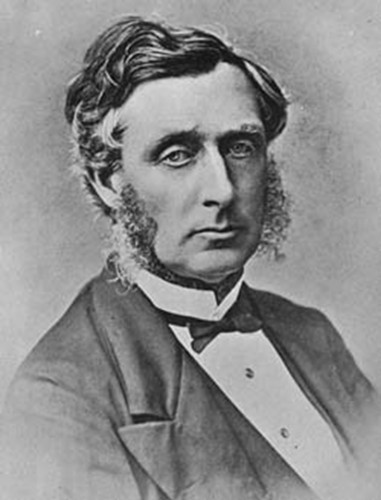
Thomas Sutcliffe Mort
Plate I · T. S. Mort, c. 1860 · Founder
23 December 1816 — 9 May 1878
Born at Willowfield in Bolton, Lancashire — second son of Jonathan and Mary Mort — Thomas was educated at Manchester Grammar School and apprenticed to the cotton firm of A. & S. Henry. When his father's affairs failed in 1834, the comfortable start he had expected vanished.
At twenty-one he sailed for Sydney aboard the Superb, arriving in February 1838 with little beyond letters of introduction. For five years he clerked at Aspinall, Browne & Co., until that firm too collapsed in the financial crisis of 1843. With his employer ruined and the colony in depression, Mort took the only course left to him: he opened his own auction rooms and held what is generally regarded as the first specialised public wool sale in Australia.
From that unpromising beginning came a career almost without parallel in colonial commerce. Wool broker, dock-builder, refrigeration pioneer, dairy industrialist, philanthropist — the breadth of his ambition was already legendary in his own lifetime.
The greatest benefactor that the working classes in this country ever had. — Spoken at his funeral, May 1878
He was a founding director of the Australian Mutual Provident Society — known today as AMP — a director of the Sydney Railway Company, and in 1852 floated the first registered goldmining company in the colony. He helped finance Henry Parkes's Empire newspaper and held founding interests across sugar, cotton, silk, copper, coal, tin and steam navigation.
Mort died at Bodalla on 9 May 1878, of pneumonia contracted while attending a sick employee in the night. He was buried at the Home Farm, in a spot he had chosen himself. Five years later, Sydney unveiled the first public statue erected to honour any Australian — it still stands at Macquarie Place.
A Life in Commerce
Second son of Jonathan and Mary Mort, Thomas grew up in a middle-class English family before the collapse of his father's affairs altered his course entirely.
Sailed aboard the Superb, arriving in February with letters of introduction. Took work as a clerk at Aspinall, Browne & Co., trading colonial wool, hides and tallow.
Opens his own auction rooms at the height of the colony's depression and conducts what is regarded as the first specialised public wool sale in Australia.
Helps establish the Australian Mutual Provident Society, which endures today as AMP Limited, one of Australia's largest financial services companies.
Australia's first completed dry dock opens at Waterview Bay. Under Mort's sole ownership from 1866, it grew to include iron foundries, a patent slip and a full engineering shop — producing the first locomotive built entirely in Australia in 1870.
Purchases 12,998 acres of the 'Boat Alley' property on the Tuross River. Within months, 13,000 acres were surveyed for an ambitious new pastoral and dairy enterprise.
Becomes sole owner of Bodalla and begins the transformation of a beef station into the model dairy estate of New South Wales. Engages Edmund Blacket to design the Comerang homestead.
Introduces a centralised dairy factory at Bodalla, replacing the cottage industry with consistent, large-scale production. Bodalla Cheddar becomes renowned throughout the colony.
Funds engineer Eugène Nicolle to develop mechanical refrigeration for the export of frozen meat to Britain — twelve years ahead of the technology finally succeeding.
A new village is built on the main southern road — store, smithy, bakery, carpenter's shop, company office, public hall and workers' cottages — every building owned by the Estate.
Dies of pneumonia on 9 May 1878, reportedly contracted attending a sick worker in the night. He was buried at the Home Farm. The estate is valued at £600,000.
Sydney unveils a statue to Mort at Macquarie Place — the first public statue erected to honour any Australian. It still stands today.
The memorial church designed by Edmund Blacket is completed, dedicated to the memory of Thomas and Theresa Mort. Its Henry Willis & Sons pipe organ, installed in 1882, is one of only seven in existence.
Mort & Co. merges with R. Goldsbrough & Co. to form one of Australia's most enduring commercial names — the holding company that still preserves the Mort family's interests today.
Heritage
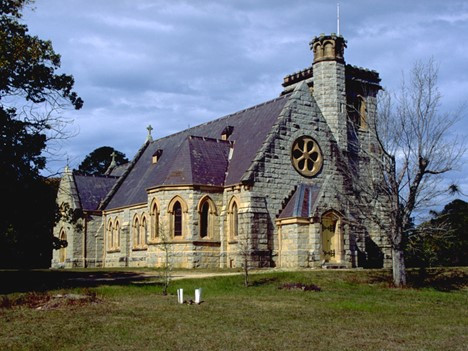
All Saints Anglican Church, Bodalla — completed 1901.
Designed by Edmund Blacket. A memorial to Thomas & Theresa Mort.
When Thomas Mort died in 1878, the people of Bodalla resolved to build a church in his memory. The family commissioned Edmund Blacket — already celebrated for Sydney's St Andrew's Cathedral and the University of Sydney's Great Hall — to enlarge his original plans to include a rose window on the west end as a memorial.
The foundation stone was laid on 18 March 1880 by Marianne Mort, Thomas's second wife. Constructed in the Victorian Academic Gothic style from local granite, the church was completed in 1901 and stands today as one of the finest small churches on the New South Wales South Coast.
Inside, the church houses one of only seven Henry Willis & Sons pipe organs in the world — built in 1881 and installed the following year. The windows Thomas had ordered from England arrived as planned, a final reminder of the scale of his ambitions for this place.
The village of Bodalla and its surrounding cultural landscape are listed as a heritage area by the NSW Government. The historic streetscape — including cottages, the company store, and public buildings constructed under the Estate — reflects what was, in its time, one of the most deliberately planned rural communities in colonial Australia.
The Bodalla Heritage Area is recognised not only for its architecture and built fabric, but for the story it tells of a particular vision of how land, labour, commerce and community could be brought together in service of each other.
Australian Dairying
Thomas Mort's contribution to Australian agriculture did not end with the scale of what he built at Bodalla. It lies in what he changed. Before 1864, cheese-making in NSW was a cottage industry — variable in quality, small in scale, reliant on individual farms selling independently. Mort changed all of that.
By introducing a centralised factory system at Bodalla, drawing milk from multiple farms and processing it under controlled conditions, Mort produced a consistent, high-quality Cheddar that could compete with English imports and carry the Bodalla name into Sydney markets as a recognised brand. By March 1864 the estate was producing approximately one ton of cheese per week.
Within a decade the estate's annual cheese production had risen to around 300 tons per year. The Bodalla brand was promoted with extraordinary imagination — including, for Christmas 1892, two cheeses weighing 4,000 lb and 3,000 lb respectively, each containing £30 in half-sovereigns, carted through Sydney's streets on eighteen-bullock teams to maximum effect.
Factory system introduced — the moment cottage dairying became industrial agriculture in Australia.
Australia's first commercial cheese and first cheese exports were made at Bodalla — a founding chapter in the nation's agricultural trade.
The estate's cheese brand became one of colonial NSW's most recognised food products — quality, consistency, and scale setting the benchmark.
Dairy farming continues in the Bodalla district today. The tradition that Mort began has outlasted the estate itself by more than a century.
The Mort Family
Bodalla Estate is part of a wider web of Mort family interests — enterprises and legacies that trace their origins to the same man and the same era. From the wool auction rooms of 1843 Sydney to the dry dock at Balmain, to the south-coast pastures of Bodalla, the Mort name is woven into the fabric of colonial and modern Australia alike.
The holding company for Mort family interests. Tracing its lineage to Thomas Sutcliffe Mort's first wool auction in 1843, Goldsbrough Mort today stewards the family's capital, operating interests and philanthropic commitments across six generations.
goldsbroughmort.com.auIn 1854 Mort laid the foundation stone of Sydney's first dry dock at Waterview Bay, Balmain. It opened on the first day of 1855 — Australia's earliest completed dry dock and for decades its largest. In 1870 it produced the first locomotive built entirely in Australia.
mortsdock.com.auThe southern Sydney suburb of Mortdale and its main road, Morts Road, bear Thomas Mort's name. His Gothic-revival home at Darling Point — Greenoaks — was acquired by the Anglican Diocese in 1910 and has served as Bishopscourt, the Archbishop's residence, ever since.
mortsroad.com.au